Blog
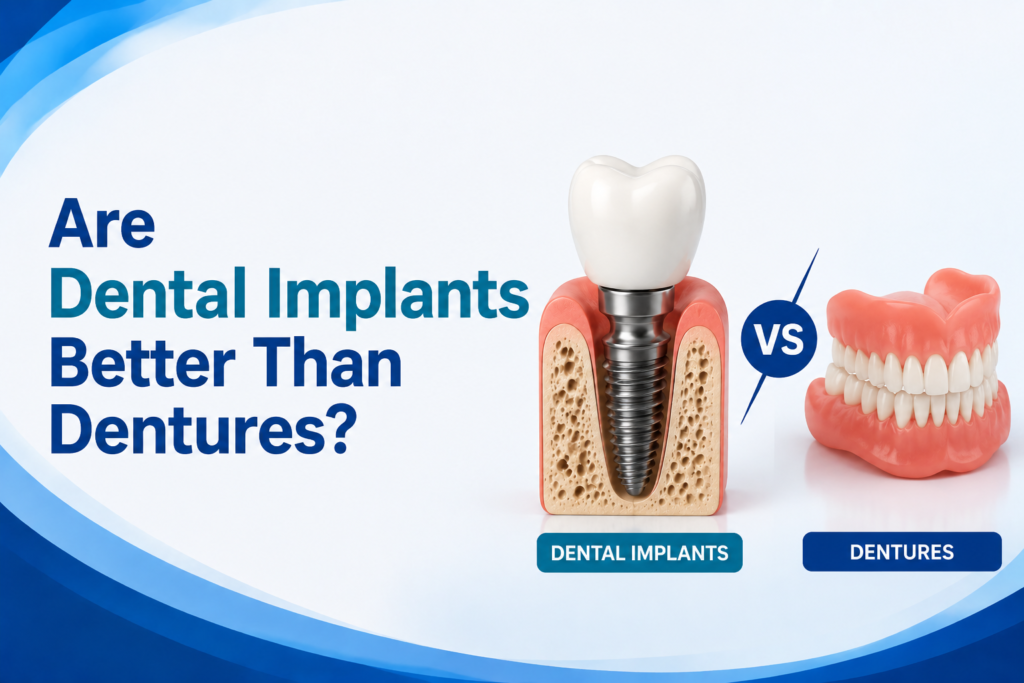
Are Dental Implants Better Than Dentures?
Losing one or more teeth can affect your ability to eat, speak, and smile with confidence. Fortunately, modern dentistry offers several reliable ways to replace missing teeth, with dental implants and dentures being two of the most common options. Both treatments restore your smile, but they differ in comfort, function, maintenance, cost, and long-term results.
Choosing between dental implants and dentures depends on your oral health, lifestyle, budget, and personal preferences. While dental implants provide a permanent solution that closely resembles natural teeth, dentures offer a more affordable and non-surgical alternative for many patients.
Understanding the advantages and limitations of each option can help you make an informed decision. This guide compares dental implants and dentures to explain how they differ and which treatment may be the better choice for your individual needs.
What Are Dental Implants?
Dental implants are artificial tooth roots that are placed into the jawbone during a minor surgical procedure. They are usually made from titanium, a material that naturally bonds with the surrounding bone during healing.
Once the implant has fully integrated with the jawbone, a custom-made dental crown, bridge, or full arch of replacement teeth is attached. The result is a stable and natural-looking tooth replacement that functions much like a real tooth.
Dental implants can replace a single missing tooth, several missing teeth, or support a complete set of replacement teeth.
What Are Dentures?
Dentures are removable appliances designed to replace missing teeth and the surrounding gum tissue.
There are two main types of dentures. Full dentures replace all the teeth in the upper or lower jaw, while partial dentures replace several missing teeth when some natural teeth remain.
Modern dentures are custom-made to improve appearance and restore basic chewing function. They can be removed for cleaning and while sleeping, making them a flexible treatment option for many patients.
Appearance: Which Looks More Natural?
Both dental implants and modern dentures are designed to improve the appearance of your smile.
Dental implants generally provide the most natural appearance because they emerge from the gums like natural teeth. Each replacement tooth is individually designed to match the color, shape, and size of your existing teeth.
Dentures also create an attractive smile, but they rest on top of the gums rather than being anchored within the jawbone. Although modern dentures have improved significantly, they may not always provide the same natural appearance as dental implants.
Read more : Dental Implants vs Dentures: Which Option Is Right for You?
Comfort: Which Feels More Like Natural Teeth?
Comfort is one of the biggest differences between these two treatments.
Dental implants become securely attached to the jawbone, allowing them to feel very similar to natural teeth. Once healing is complete, many patients forget they even have an implant because it remains stable during eating and speaking.
Dentures rest on the gums and may require time to adjust. Some people experience minor movement, pressure, or sore spots, particularly when first wearing them. Regular adjustments may also be needed as the shape of the gums changes over time.
For patients seeking the closest experience to natural teeth, dental implants often provide greater comfort.
Chewing Ability
Being able to eat comfortably is an important part of maintaining good nutrition and quality of life.
Dental implants provide excellent chewing strength because they are securely anchored in the jawbone. Most patients can comfortably eat a wide variety of foods, including foods that require more chewing.
Dentures restore chewing ability but may not provide the same level of stability. Hard, sticky, or chewy foods can sometimes cause dentures to move, making eating less comfortable for some patients.
As a result, dental implants generally offer better chewing performance.
Stability During Daily Activities
Dental implants remain firmly in place throughout the day.
Patients can speak, laugh, and eat without worrying about movement. Because implants are fixed in the jawbone, they do not require adhesives to stay secure.
Dentures are designed to fit snugly, but they may occasionally shift during eating or speaking. Some patients use denture adhesive to improve stability, while others require periodic adjustments to maintain a comfortable fit.
Jawbone Health
One of the biggest advantages of dental implants is their ability to preserve jawbone health.
When a natural tooth is lost, the jawbone beneath it gradually shrinks because it no longer receives stimulation during chewing. Dental implants replace the tooth root and continue providing this stimulation, helping maintain bone strength and facial structure.
Dentures do not replace the tooth roots. As a result, the jawbone may continue to shrink over time, which can gradually affect the fit of the dentures and alter facial appearance.
Caring for Dental Implants and Dentures
Both treatment options require daily care to maintain good oral health.
Dental implants are cleaned much like natural teeth. Brushing twice a day, cleaning between the teeth, and attending regular dental checkups help keep both the implant and surrounding gums healthy.
Dentures should be removed each day for cleaning. They also need to be soaked according to your dentist’s instructions and cleaned carefully before being worn again. In addition, the gums should be cleaned regularly to maintain healthy oral tissues.
Although both require proper maintenance, many patients find caring for dental implants more similar to their usual oral hygiene routine.
Durability and Lifespan
Dental implants are designed to provide a long-lasting solution for missing teeth.
With proper care, the implant itself can often last twenty years or longer, and many remain successful for a lifetime. The attached dental crown may eventually need replacement because of normal wear, but the implant foundation frequently remains stable.
Dentures usually last between five and ten years before replacement or relining becomes necessary because the shape of the gums and jawbone changes over time.
The longer lifespan of dental implants often makes them a valuable long-term investment.
Cost Comparison
One of the biggest differences between dental implants and dentures is the initial cost.
Dental implants generally involve a higher upfront investment because they require surgery, custom restorations, and several stages of treatment. However, their durability often reduces the need for frequent replacement.
Dentures usually have a lower initial cost, making them an attractive option for patients with budget considerations. Over time, however, adjustments, repairs, relining, or replacement may add to the overall cost.
When evaluating treatment options, it is helpful to consider both the immediate expense and the long-term value.
Who Is a Good Candidate for Dental Implants?
Dental implants are suitable for many adults with missing teeth.
Good candidates typically have healthy gums, sufficient jawbone to support the implant, and good overall health. Patients who smoke or have certain medical conditions may require additional evaluation before treatment.
Even individuals with some bone loss may still qualify after procedures such as bone grafting.
Who May Benefit More from Dentures?
Dentures may be the better choice for patients who have lost many or all of their teeth and prefer a non-surgical treatment.
They are also suitable for individuals who may not have enough jawbone for implants or who are looking for a more affordable replacement option.
Your dentist will evaluate your oral health and discuss which treatment best meets your needs.
Can Dental Implants and Dentures Be Combined?
Yes. Implant-supported dentures combine the advantages of both treatments.
In this approach, a few strategically placed dental implants securely anchor a removable denture. This provides greater stability than traditional dentures while using fewer implants than replacing every missing tooth individually.
Many patients appreciate the improved comfort and chewing ability offered by implant-supported dentures.
Which Option Is Better?
There is no single answer that applies to everyone.
Dental implants are often considered the best long-term solution because they provide excellent stability, preserve jawbone health, protect neighboring teeth, and closely resemble natural teeth in both appearance and function.
Dentures remain an effective option for patients who prefer a removable solution, have extensive tooth loss, or are seeking a more affordable treatment.
The right choice depends on your oral health, personal goals, budget, and recommendations from your dentist.
Conclusion
Both dental implants and dentures are effective ways to replace missing teeth, but they offer different benefits. Dental implants provide greater stability, improved chewing ability, a more natural appearance, and long-term preservation of the jawbone. Dentures offer a practical and more affordable solution, particularly for patients replacing multiple missing teeth or those who prefer to avoid surgery.
The best treatment is the one that fits your individual needs and long-term oral health goals. A comprehensive dental examination allows your dentist to recommend the most suitable option based on your smile, lifestyle, and overall dental health. By choosing the right tooth replacement solution, you can restore your confidence, improve daily comfort, and protect your oral health for many years to come.
Contact us for more information

At Square One Health Group, we are a dedicated team of professionals providing compassionate, patient-focused heath care in Mississauga. We specialize in family medicine, preventive health, dental care and wellness, helping patients achieve long-term health through personalized care.