Blog
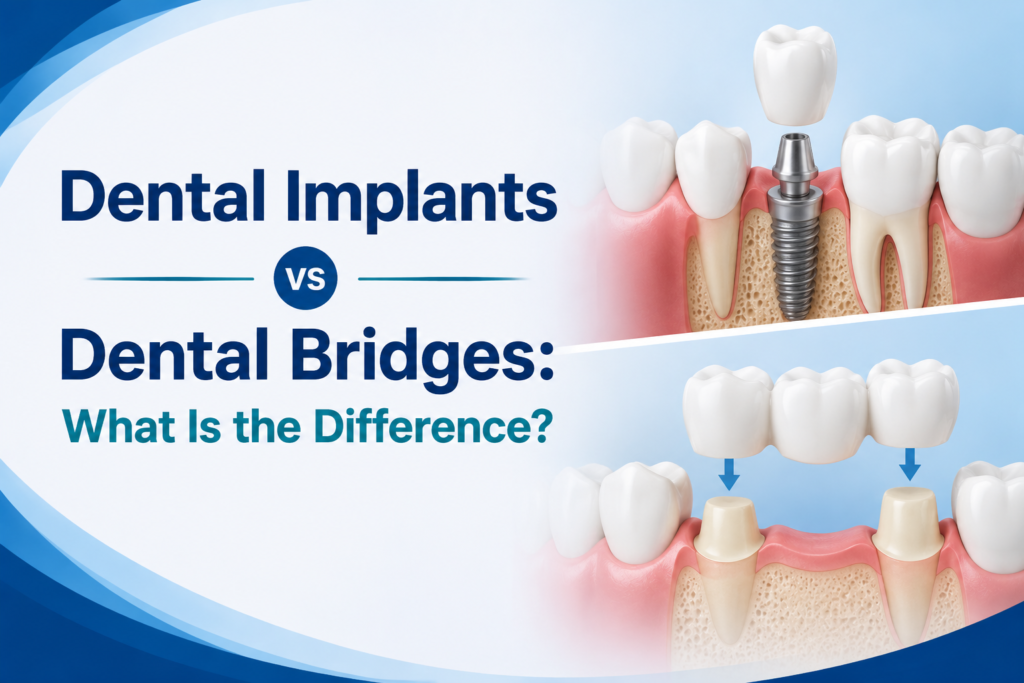
Dental Implants vs Dental Bridges: What Is the Difference?
Missing teeth can affect your smile, confidence, and overall oral health. They can also make everyday activities such as eating and speaking more difficult. Fortunately, modern dentistry offers several effective ways to replace missing teeth, with dental implants and dental bridges being two of the most common options.
Although both treatments restore the appearance and function of your smile, they work in different ways and offer different advantages. Choosing the right option depends on several factors, including your oral health, the condition of your surrounding teeth, your budget, and your long-term goals.
When deciding between a dental implant and a dental bridge, understanding the differences can help you make a confident and informed choice. This guide explains how each treatment works, their benefits and limitations, and which option may be better for your needs.
What Is a Dental Implant?
A dental implant is an artificial tooth root that replaces both the root and the visible portion of a missing tooth.
The implant, usually made from titanium, is surgically placed into the jawbone. Over the next several months, the jawbone naturally bonds with the implant, creating a strong and stable foundation. Once healing is complete, a custom-made dental crown is attached to the implant, giving it the appearance and function of a natural tooth.
Dental implants can replace a single missing tooth, multiple missing teeth, or support a full set of replacement teeth.
What Is a Dental Bridge?
A dental bridge is a fixed dental restoration that replaces one or more missing teeth by using the neighboring teeth for support.
The artificial tooth, known as a pontic, is attached to dental crowns placed on the teeth located on either side of the gap. These supporting teeth are carefully reshaped so the crowns fit securely.
Once the bridge is permanently cemented into place, it restores your smile and improves chewing ability without being removable.
How Do Dental Implants and Dental Bridges Differ?
Although both treatments replace missing teeth, their approach is very different.
A dental implant replaces the missing tooth root and functions independently without relying on surrounding teeth. A dental bridge fills the gap by attaching to the neighboring teeth, making those teeth responsible for supporting the replacement.
This fundamental difference influences treatment time, durability, maintenance, and long-term oral health.
Appearance
Both dental implants and dental bridges are designed to blend naturally with your smile.
Dental implants usually provide the most natural appearance because they emerge directly from the gums like a natural tooth. The custom-made crown is carefully matched to your surrounding teeth in shape, color, and size.
Dental bridges also provide excellent cosmetic results. However, because they are connected to neighboring crowns, they may not perfectly replicate the appearance of an individual natural tooth in every case.
Both options can produce attractive, natural-looking smiles when properly designed.
Treatment Procedure
The treatment process differs significantly between dental implants and dental bridges.
Dental implant treatment involves placing the implant into the jawbone through a minor surgical procedure. After the implant heals and bonds with the bone over several months, the permanent crown is attached.
A dental bridge does not require surgery. Instead, the supporting teeth are prepared, impressions are taken, and the custom bridge is fabricated. In most cases, treatment is completed within two or three appointments over a few weeks.
Patients looking for a quicker solution may prefer a dental bridge, while those seeking a long-term replacement often choose dental implants.
Treatment Time
The overall timeline is another important difference.
Dental implants generally require between three and nine months from consultation to completion because healing between the implant and jawbone is essential.
Dental bridges are usually completed within two to four weeks, depending on the dental laboratory and the complexity of the treatment.
Although implants require more time, the healing process contributes to their long-term stability.
Effect on Surrounding Teeth
One of the biggest advantages of dental implants is that they do not affect neighboring healthy teeth.
Each implant stands independently, allowing adjacent teeth to remain untouched. This helps preserve healthy tooth structure and reduces unnecessary treatment.
Dental bridges require the neighboring teeth to be reshaped so they can support the crowns that hold the bridge in place. If these teeth are already heavily restored, a bridge may still be an excellent option. However, if the surrounding teeth are healthy, preserving them with a dental implant may be preferable.
Jawbone Health
Dental implants provide an important benefit that bridges cannot.
When a tooth is lost, the jawbone beneath it gradually shrinks because it no longer receives stimulation during chewing. Dental implants replace the missing tooth root and continue stimulating the jawbone, helping preserve its strength and volume.
Dental bridges restore the visible portion of the tooth but do not replace the root. As a result, bone loss beneath the missing tooth may continue over time.
For many patients, preserving jawbone health is a significant advantage of dental implants.
Durability
Both dental implants and dental bridges are designed to provide many years of reliable function.
With proper care, the implant itself can often last twenty years or longer, and many remain successful for a lifetime. The attached dental crown may eventually require replacement because of normal wear.
Dental bridges typically last between ten and fifteen years, although many continue functioning well beyond that with excellent oral hygiene and regular dental care.
Daily maintenance and routine dental examinations play an important role in extending the lifespan of either treatment.
Cost Comparison
Dental implants generally have a higher initial cost than dental bridges.
The additional cost reflects the surgical procedure, advanced materials, and longer treatment process. However, implants often provide greater long-term value because they can last for decades with proper care.
Dental bridges usually involve a lower upfront investment, making them an attractive choice for many patients. Over time, however, replacement or additional treatment involving the supporting teeth may increase future costs.
When comparing expenses, it is important to consider both immediate costs and long-term value.
Oral Hygiene and Maintenance
Both dental implants and dental bridges require excellent oral hygiene.
Dental implants are cleaned much like natural teeth. Brushing twice a day, cleaning between the teeth, and attending regular dental checkups help maintain healthy gums and support long-term success.
Dental bridges also require careful cleaning. Special flossing techniques or interdental cleaning tools may be needed to clean beneath the artificial tooth and prevent plaque buildup around the supporting teeth.
Following your dentist’s recommendations helps protect either restoration for many years.
Who Is a Good Candidate for a Dental Implant?
Dental implants are often recommended for patients who:
- Have one or more missing teeth.
- Have healthy gums.
- Have enough jawbone to support an implant.
- Want a long-lasting solution.
- Prefer to preserve neighboring healthy teeth.
Some patients who have experienced bone loss may still qualify after bone grafting or other preparatory treatment.
Read more : 5 Ways Dental Implants Can Improve Your Oral Health
Who May Benefit More from a Dental Bridge?
A dental bridge may be a suitable choice for patients who:
- Want a faster tooth replacement.
- Prefer to avoid oral surgery.
- Have neighboring teeth that already require crowns.
- Are looking for a lower initial treatment cost.
Your dentist will evaluate your oral health and recommend the option that best fits your needs.
Which Option Is Better?
There is no single answer that applies to everyone.
Dental implants are often considered the preferred long-term solution because they preserve jawbone health, protect neighboring teeth, and provide exceptional durability. They closely resemble natural teeth in appearance and function, making them an excellent investment for many patients.
Dental bridges remain a highly effective treatment for replacing missing teeth, particularly when surgery is not suitable or when a faster treatment timeline is preferred.
The best choice depends on your oral health, treatment goals, budget, and your dentist’s recommendations.
Conclusion
Both dental implants and dental bridges are proven solutions for replacing missing teeth and restoring your smile. Dental implants provide excellent stability, preserve jawbone health, and protect surrounding teeth, making them an outstanding long-term investment. Dental bridges offer a reliable, faster, and less invasive alternative that can restore function and appearance in just a few appointments.
A comprehensive dental examination is the best way to determine which treatment is right for you. By discussing your oral health, lifestyle, and long-term goals with your dentist, you can choose a solution that restores your smile, improves your comfort, and supports lasting oral health. Contact us for more information,

At Square One Health Group, we are a dedicated team of professionals providing compassionate, patient-focused heath care in Mississauga. We specialize in family medicine, preventive health, dental care and wellness, helping patients achieve long-term health through personalized care.