Blog
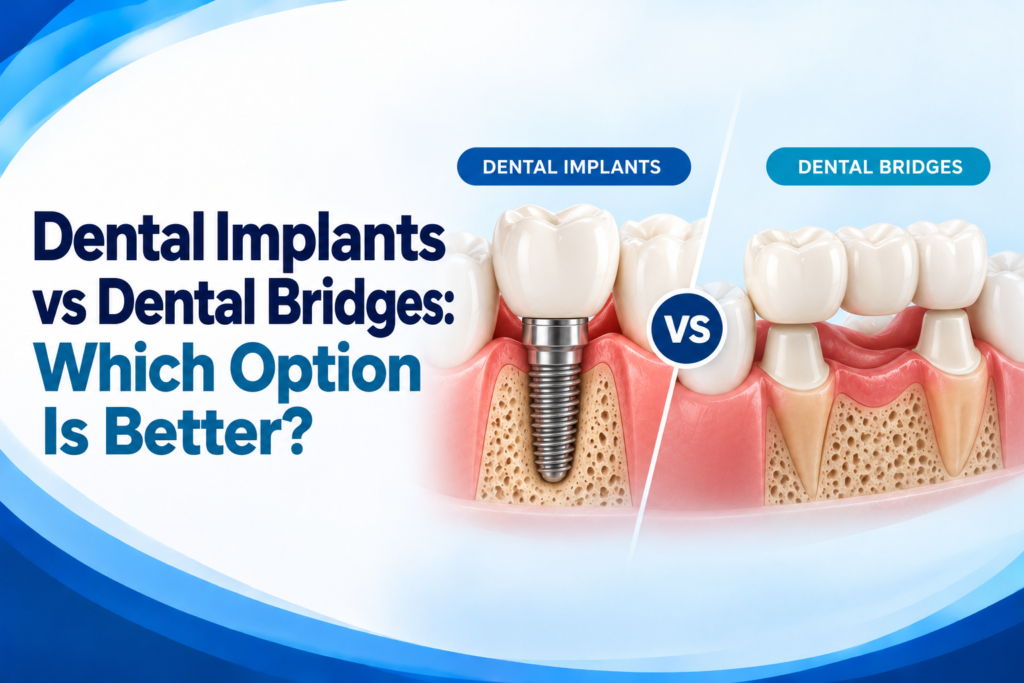
Dental Implants vs. Dental Bridges: Which Option Is Better?
Missing a tooth can affect much more than the appearance of your smile. It can make chewing difficult, affect speech, and allow nearby teeth to move into the empty space. Fortunately, modern dentistry offers several ways to replace missing teeth, with dental implants and dental bridges being two of the most common options.
Both treatments can restore the appearance and function of your smile, but they work differently. A dental implant replaces the missing tooth root and supports a crown, while a dental bridge uses neighbouring teeth to support an artificial tooth. The better option depends on your oral health, jawbone condition, treatment preferences, budget, and long-term goals.
What Are Dental Implants?
A dental implant is a small post placed into the jawbone to replace the root of a missing tooth. After the implant heals and becomes securely integrated with the surrounding bone, a dental crown is attached to complete the restoration.
One of the main advantages of an implant is that it stands independently. It does not normally require the neighbouring teeth to be reshaped or used as support. This makes dental implants a popular choice for people who want to replace a missing tooth while preserving the structure of healthy teeth nearby.
Because the implant is placed in the jawbone, it can also help maintain the bone in the area where the tooth was lost.
What Is a Dental Bridge?
A dental bridge fills the space created by a missing tooth using an artificial tooth supported by neighbouring teeth. In a traditional bridge, the teeth on either side of the gap are prepared so that crowns can be placed over them.
A bridge does not require implant surgery or the same bone-healing period associated with an implant. This can make it an attractive option for patients who want a quicker restoration or are not suitable candidates for implant treatment.
The health and strength of the supporting teeth are important because they carry the additional load created by the bridge.
Dental Implants vs. Dental Bridges: What Is the Difference?
The biggest difference is how each treatment is supported. A dental implant is anchored in the jawbone, while a traditional dental bridge relies on neighbouring teeth.
Implant treatment usually takes longer because the implant needs time to heal before the final crown is attached. A bridge can often be completed in a shorter period because it does not require the same surgical healing process.
There is also a difference in how the surrounding teeth are treated. An implant can replace the missing tooth without preparing healthy neighbouring teeth, whereas a traditional bridge generally requires some alteration of the supporting teeth.
Which Option Looks More Natural?
Both dental implants and bridges can provide attractive and natural-looking results. Dental crowns and bridge teeth can be designed to match the colour, shape, and size of your surrounding teeth.
An implant can closely resemble a natural tooth because it replaces the root and supports a crown independently. The crown is positioned within the space left by the missing tooth, which can create a natural appearance.
The final result depends on factors such as the position of the missing tooth, gum health, restoration material, and the treatment plan created by your dental professional.
Which Treatment Lasts Longer?
Dental implants are designed as a long-term tooth replacement solution and can remain functional for many years or even decades when properly maintained. The implant itself can be highly durable, although the crown attached to it may eventually need repair or replacement because of normal wear.
Dental bridges can also last for many years with proper oral hygiene and regular dental care. Their longevity partly depends on the condition of the supporting teeth and gums.
If the teeth supporting a bridge develop decay, gum disease, or structural problems, the bridge may also be affected. This is one reason why maintaining the surrounding teeth is particularly important with bridge treatment.
Which Is More Affordable?
The cost of replacing a missing tooth varies according to the treatment, materials, number of teeth involved, and procedures required.
Dental implants often have a higher initial cost because treatment may involve implant placement, an abutment, a crown, and sometimes additional procedures such as bone grafting. However, their long-term durability can make them a valuable investment for some patients.
A dental bridge may have a lower initial cost and generally requires fewer treatment stages. However, the supporting teeth may eventually require additional dental treatment, and the bridge itself may need replacement.
Instead of comparing only the initial price, consider the expected lifespan, maintenance requirements, and future dental care associated with each option.
Which Treatment Is Faster?
If treatment time is an important consideration, a dental bridge may have an advantage. Once the supporting teeth are prepared and the necessary impressions or scans are completed, the bridge can generally be created and fitted without waiting for an implant to integrate with the jawbone.
Dental implant treatment usually involves a longer process. After implant placement, the jawbone needs time to heal around the implant before the final restoration can be attached.
The exact timeline varies between patients. If bone grafting or other preparatory treatment is needed, implant treatment can take longer.
Which Option Is Easier to Maintain?
Both options require regular dental care and good daily oral hygiene. A bridge requires particular attention underneath the artificial tooth and around the supporting teeth. Your dentist may recommend floss threaders, interdental brushes, or other cleaning tools.
Dental implants also need regular cleaning around the crown and gumline. Although an implant cannot develop tooth decay like a natural tooth, the surrounding gums and bone can still be affected by bacterial buildup.
Regular dental examinations are important for both treatments because they allow your dentist to check the restoration and surrounding tissues.
Who Is a Good Candidate for Dental Implants?
Dental implants may be suitable for adults with healthy gums, adequate jawbone support, and good oral health. Your dentist will examine the condition of your jawbone and surrounding tissues before recommending treatment.
If there is not enough bone to support an implant, a bone graft may sometimes be recommended. Certain health and lifestyle factors can also influence healing, so your dental professional will consider your individual circumstances.
Read more : What Can You Expect with Dental Implant Treatment?
Who May Benefit From a Dental Bridge?
A dental bridge may be appropriate when the teeth next to the missing tooth are healthy and strong enough to provide support. It can also be an option for people who prefer to avoid implant surgery or want a faster tooth replacement process.
A bridge may be especially practical when the neighbouring teeth already require crowns or substantial restoration. In such cases, using those teeth to support a bridge may be a reasonable part of the overall treatment plan.
Frequently Asked Questions
Are dental implants better than dental bridges?
Neither treatment is automatically better for every patient. Implants can provide an independent, long-term replacement, while bridges can offer a faster treatment without implant surgery. Your dentist can recommend an option based on your oral health and specific needs.
Are dental bridges cheaper than implants?
A bridge may cost less initially, but the price varies depending on the materials, number of teeth involved, and complexity of treatment. Long-term maintenance should also be considered when comparing costs.
Do dental implants last longer than bridges?
Dental implants can remain functional for many years and potentially decades with proper care. Bridges can also be long-lasting, but their durability depends partly on the supporting teeth and surrounding gums.
Can a dental implant look like a natural tooth?
Yes. A dental implant can support a custom-made crown designed to match your natural teeth in colour, size, and shape.
Is getting a dental implant painful?
The implant procedure is performed using anesthesia to keep you comfortable. Some soreness, swelling, or tenderness can occur afterward while the area heals.
Can I get a bridge instead of an implant?
In many cases, a bridge can be an alternative to an implant. However, the suitability of either treatment depends on the condition of your teeth, gums, jawbone, and overall oral health.
Final Thoughts
Choosing between dental implants vs. dental bridges requires more than comparing prices or treatment times. Implants can provide an independent and durable replacement without relying on neighbouring teeth, while bridges can restore a missing tooth more quickly and without implant surgery.
The right choice depends on the condition of your mouth, your long-term expectations, treatment preferences, and budget. A thorough dental examination can help you understand the advantages and limitations of both options and determine which solution is most appropriate for your smile.

At Square One Health Group, we are a dedicated team of professionals providing compassionate, patient-focused heath care in Mississauga. We specialize in family medicine, preventive health, dental care and wellness, helping patients achieve long-term health through personalized care.